 USA
USA  Canada
  Brazil
  Germany
  France
  Italy
Italy  Switzerland
  Sweden
  Spain
Spain  Great Britain
  Norway
  Russia
  Japan
Japan  New Zealand
  Australia
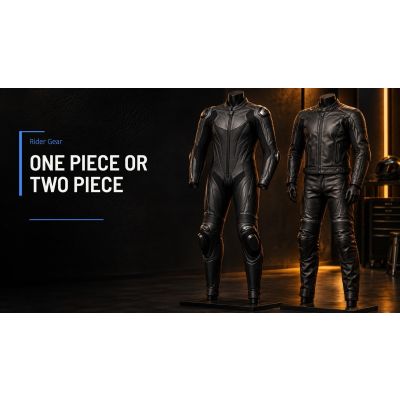
A one-piece race suit is a single garment with no join at the waist, while a two-piece suit is a separate jacket and trousers, usually connected by a zip around the waist. Neither format wins outright: the right choice depends on where the rider rides, how the suit fits, how often it travels and what the track or event requires. This guide compares the two formats so the decision rests on riding style and fit.
Key Takeaways
- A one-piece suit is a single garment; a two-piece is a jacket and trousers that usually connect with a zip.
- Protection depends on the specific suit's materials, construction and armour, not on the format alone.
- Two-piece suits allow different sizes for the top and bottom and are easier to pack and put on.
- Check the event or track-day rules before buying, since organisers set their own requirements.
One-piece vs two-piece: the basic difference
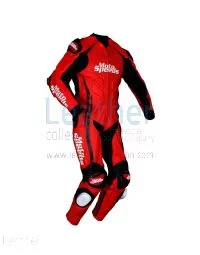
The difference is structural. A one-piece suit is cut as a single garment, so the back panel and the hip area are continuous from shoulder to ankle. Browsing shows how the format looks in practice: one entry zip, usually along the front, with a connected cut across the whole body.
A two-piece suit splits at the waist. The jacket and the trousers are made as separate pieces, and many are designed to join with a zip around the midsection so that the two halves behave as one garment on the bike. The range covers this format. The zip join is where two-piece designs need the most attention, because it is the one place where the garment relies on a fastening rather than on continuous leather.
Protection and standards: what the format changes
Format alone does not set the protection level. What matters is the leather, the stitching, the armour in the shoulders, elbows, knees and hips, and how well the suit stays in place during a slide. EN 17092 is the European standard for protective motorcycle garments and has five classes: AAA, AA, A, B and C. According to SATRA, abrasion resistance is assessed on a Darmstadt machine.
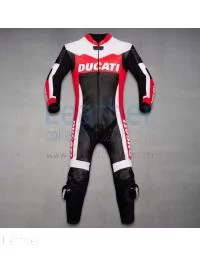
A class applies to a specific tested garment. It says nothing about whether one-piece or two-piece is better in general, and a class should not be assumed from the format. For any suit, check the armour its product page lists and ask for the documentation that applies to the exact garment. For example, the product page of the Ducati-style two-piece listing below names external CE protectors at the shoulders, elbows and knees and also shows a CE Level 2 entry among its add-ons, so what comes with an order is worth confirming.
In professional racing, protective equipment is regulated. Crash.net reported that, since the 2018 season, airbag-equipped suits have been compulsory for permanent riders in MotoGP, Moto2 and Moto3, with wild-card riders initially exempt. That is a rulebook for one series, not a recommendation for every road or track-day rider.
Fit and comfort on the bike
A one-piece suit is cut for the riding position. It is usually shaped with a tucked, crouched posture in mind, so it may feel stiff or restrictive when standing, walking or sitting upright. Because the entire suit must fit in one size, riders whose chest and leg measurements differ can find a single garment harder to fit.
A two-piece suit solves part of this. Each half is sized on its own, so a rider with a larger upper body and shorter legs, or the reverse, can order the jacket and trousers separately. Wearing the trousers alone between sessions is also practical in the paddock. The compromise is the waist join: it needs to lie flat in the riding position, without bunching at the stomach or riding up at the back.
Whatever the format, fit is checked on the bike. Standing, tucked and braced positions all load the suit differently, and the suit should allow a full range of movement without folds that press against the body. Sizing details are covered in the maker's measurement guide and, for made-to-measure orders, in the measurements supplied with the order.
Practical differences: putting on, travel and use
The practical gap shows up away from the track. A one-piece suit usually takes longer to put on and take off, and many riders find it can be harder to cool down in warm weather between sessions. A two-piece suit lets the rider open the jacket, remove one half or change just one part. It also packs into a bag more easily than a single long garment.
| Feature | One-piece suit | Two-piece suit |
|---|---|---|
| Construction | Single garment, no waist join | Jacket and trousers, usually joined by a zip |
| Sizing | One size for the whole body | Top and bottom can be sized separately |
| Putting on | Entry through one zip, takes longer | Two pieces, can be put on in stages |
| Use between sessions | Needs to be worn whole or taken off completely | Jacket can be removed while trousers stay on |
| Rule checks | Check the organiser's gear rules for both formats | Check the organiser's gear rules for both formats |
For general street-oriented leather riding, a separate jacket is also a common choice, since it can be worn off the bike. The same applies to the overall wardrobe: a one-piece suit is a dedicated riding garment, while a two-piece can be split into jacket and trousers for varied use.
How to decide
Start with the rules. Track-day organisers and clubs publish gear requirements, so check them for both formats. If the rules allow both, choose by riding style and fit: a rider who spends most time tucked on a sportbike may value the continuous cut of a one-piece, while a rider who mixes road riding with occasional track days may find the flexibility of a two-piece more useful.
Next, look at the specific suits instead of the category. Compare the leather, stitching, armour options and the connection if there is one. Browse the collection for both formats, and for a classic leather design see a option. For a two-piece style, the listing is a brand-inspired design with no connection to the manufacturer, shown as editorial inspiration rather than a statement about protective ratings.
Frequently Asked Questions
Is a one-piece race suit safer than a two-piece?
Safety depends on the construction, materials, armour and fit of the individual suit, not on the format alone. A one-piece has no waist join, while a two-piece depends on a well-made connection. Standards such as EN 17092 test garments by class, so the useful comparison is between specific suits and their documentation.
Can a two-piece suit be used at a track day?
Track organisers set their own gear rules, so the answer comes from the event itself rather than from a general statement about formats. Check the organiser's gear rules before booking, and ask the maker about the connection between jacket and trousers.
Do road and track-day riders need to follow MotoGP rules?
No. Championships write their own regulations, and since the 2018 season airbag-equipped suits have been compulsory for permanent riders in MotoGP, Moto2 and Moto3, with wild-card riders initially exempt. Those rules apply to that series. They are a rulebook for professional racing, not a requirement or a recommendation that carries over to every ride. Road riders and track-day participants follow the organiser's gear rules and choose a suit by fit, riding style and the documentation for the specific garment.
Does a two-piece suit fit differently?
It can. Because the jacket and trousers are separate patterns, each half can be sized on its own, which helps riders whose upper and lower body measurements fall into different sizes. The connection still needs to sit comfortably in the riding position, so check it on the bike.
Written by the Leather Collection Editorial Team.