 USA
USA  Canada
  Brazil
  Germany
  France
  Italy
Italy  Switzerland
  Sweden
  Spain
Spain  Great Britain
  Norway
  Russia
  Japan
Japan  New Zealand
  Australia
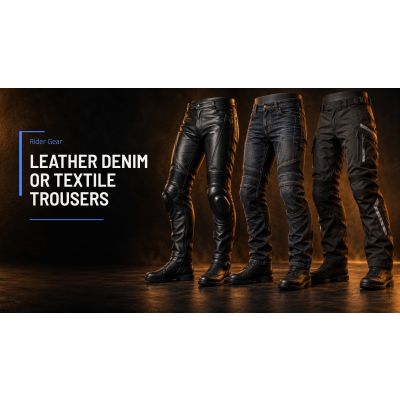
Leather, riding jeans and textile trousers each protect differently, and the material name alone does not rank them. What counts is how the garment resists sliding on asphalt, how strong its seams are, whether impact armour is fitted at the knees and hips, and how comfortable it stays over a long ride. Leather is widely used where abrasion resistance matters, but a thin or poorly stitched pair can underperform a well-built textile or jeans design. This comparison explains what to check on each type.
Key Takeaways
- Compare construction, seams, lining and armour, not just the material name.
- EN 17092 is the garment standard; it has five classes (AAA, AA, A, B, C), and the label should state which one applies to the tested garment.
- Knee and hip armour is assessed separately under EN 1621-1 and covers impact only.
- Leather is stiffer at first, jeans are the easiest to wear off the bike, and textile varies most between models.
How motorcycle trousers are judged
Two parts of a standard matter for trousers. The first is the garment standard, EN 17092, which sets requirements for protective clothing. According to SATRA, EN 17092 has classes AAA, AA, A, B and C: AAA and AA require shoulder, elbow, knee and hip impact protectors, Class A makes hip protectors optional, Class B offers Class A-level abrasion protection without impact protectors, and Class C provides impact protection only, with no minimum abrasion protection. The class on the label says something about the garment as tested, not about the material in general.
The second is the armour. SATRA describes EN 1621-1 as the test for armour worn on limb joints, such as knees and hips. It deals with impact. It does not tell a rider how a fabric slides or how a seam holds, which is why a garment and its armour are judged separately.
A SATRA bulletin notes that products often combine several layers of different thickness, and that every construction has to be tested. That is why a jeans-style garment with a reinforcing lining and a plain pair of the same cut can behave differently.
Leather trousers
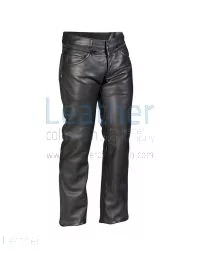
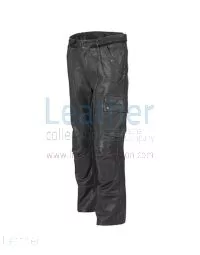
Leather is a single, continuous skin, which is why it is so widely used for abrasion zones. Its main variables are the type of hide, thickness, panel layout and stitching. A close-fitting style such as the is described on its product page for everyday casual wear, and the page does not mention riding use or armour, so it is a fashion choice rather than riding gear. A straight-leg cut like the is likewise listed for everyday and smart-casual wear and its page does not mention armour. For any pair intended for riding, look for a product page that states riding use and the armour it lists, and ask for the documentation.
In comfort terms, leather is stiff when new and often warm in hot weather, but it blocks wind well and softens with wear. Many riders find it less practical off the bike, particularly when a pair needs to be worn all day. For more on fit and everyday wear, browse the full .
Riding jeans
Riding jeans look like ordinary denim, but they are built with reinforcement in the places that matter, with some using reinforcing liners and having armour pockets. Their appeal is simple: they are easy to wear off the bike, in an office or a cafe, without looking like gear. The trade-off is that the protection comes from the lining and construction, so two pairs that look identical may differ a great deal. Check the label for an EN 17092 class and ask what armour is supplied or whether it is sold separately.
Leather also exists in a jeans cut, combining the denim silhouette with a leather exterior. That is a style choice; as with every garment here, any armour and protective documentation should be confirmed with the maker instead of assumed.
Textile trousers
Textile covers a wide range. At one end are heavy abrasion-resistant fabrics with reinforced panels, waterproof liners and ventilation zips designed for touring. At the other are light shell trousers that offer little more than weather protection. Their strengths are practical: many have removable liners, adjustable waists and several pockets, and they often handle rain better than leather. The weakness is that the category is so broad that "textile" tells a buyer almost nothing; the label, the armour and the construction do.
Textile trousers also tend to be the lightest option and the quickest to move in, which suits riders who change between warm and cold weather. As with jeans, check which EN 17092 class applies and whether the armour is included.
Side-by-side comparison
| Feature | Leather trousers | Riding jeans | Textile trousers |
|---|---|---|---|
| Abrasion behaviour | Depends on hide thickness and stitching | Depends on liner and seam construction | Depends on fabric type and reinforcement |
| Armour | Only what the product page lists | Often pockets; confirm what is supplied | Often pockets; confirm what is supplied |
| Comfort when new | Stiff, softens with wear | Familiar, flexible | Flexible, often adjustable |
| Warm weather | Warm unless perforated | Moderate | Varies, vents common |
| Wet weather | Needs care and often a rain layer | Denim absorbs water | Often waterproof liner |
| Off-bike use | Style-dependent | Easiest | Looks like gear |
Choosing between them
Start with the ride rather than the fabric. For a daily commute with frequent stops, ease of wear off the bike pushes riders toward jeans. For all-weather touring, textile with a liner is practical. For a rider who prefers leather for its look and wants closer fit, trousers are the logical choice. A rider who prefers a leather overlay worn over other clothes can look at chaps, such as the , though those are an overlay instead of a replacement for trousers.
Whatever the type, three checks apply. Read the label for the EN 17092 class. Confirm which armour is supplied or optional and ask for its documentation. Try the fit seated on a bike, because armour that shifts away from the knee is not doing its job. Fit and armour details belong in the product listing.
Care and longevity
Follow the garment's care label and the maker's instructions. The right product depends on the finish and construction of the leather, and denim or textile liners have their own rules. Follow the maker's instructions about replacing armour or garments after a crash.
Frequently Asked Questions
Are riding jeans as protective as leather trousers?
Not as a rule. Protection depends on the specific garment: the base material, the lining, the seams and whether armour is fitted. Fabric type does not settle it, so compare the labelling and documentation on each garment rather than the fabric type alone.
Can textile trousers protect better than leather?
Textile trousers vary widely. Some use abrasion-resistant fabrics with reinforced panels and armour pockets, others are light weatherproof layers with little impact protection. The material name does not settle the question; the construction, the armour and any standard marking on the label do.
Do leather trousers come with knee armour?
That depends on the model. Check what the product page lists for armour, and ask for the documentation for the armour level offered. Fashion leather trousers may state no riding use or armour at all. Do not assume a pair includes armour because the listing photos show knee panels or pockets.
What does knee and hip armour in trousers actually cover?
Knee and hip armour is assessed under EN 1621-1, which covers protectors worn on the limb joints. It addresses impact only. Abrasion and seam strength are separate matters judged for the garment as a whole under EN 17092, so both need checking on the label and documentation.
Which is easier to wear off the bike: leather, jeans or textile?
Jeans usually look least out of place off the bike, while textile trousers often add pockets or zips for fit and ventilation. Leather trousers sit in between and depend on cut and weight. Comfort is personal, so fit, lining and flexibility count more than the material label.
Written by the Leather Collection Editorial Team.