 USA
USA  Canada
  Brazil
  Germany
  France
  Italy
Italy  Switzerland
  Sweden
  Spain
Spain  Great Britain
  Norway
  Russia
  Japan
Japan  New Zealand
  Australia
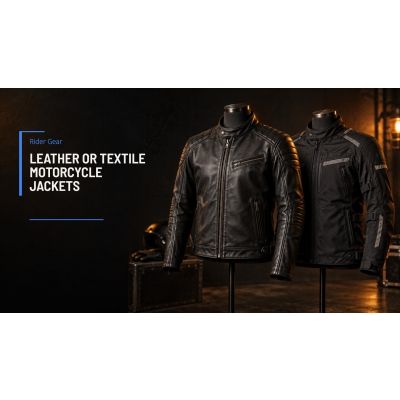
Neither material wins outright: leather is the traditional choice for abrasion resistance and a close fit, while textile jackets usually win on weather protection, ventilation and pockets. What actually changes on the road is how each jacket handles heat, rain, a slide and daily use, and how it is constructed matters as much as the material name on the label.
Key Takeaways
- Leather is thicker and stronger; textile jackets tend to add vents, liners and pockets.
- Material is only part of the picture: seams, impact protectors and fit all affect protection.
- EN 17092 classes garments from AAA to C, whatever the material.
- Climate and riding habits should decide the choice, not a single winner.
How the Materials Differ
According to Wikipedia, motorcycle leather is thick, strong and only moderately flexible, and different grades such as full grain, top grain, corrected grain and suede resist abrasion, tearing and bursting forces to different degrees. Textile jackets are built from synthetic fabrics such as ballistic nylon (Cordura) and Kevlar blends, which are lighter and offer more freedom in the design of pockets, vents and liners.
The practical consequence is that two jackets of the same material can behave very differently. Leather thickness, tanning and stitching vary, and so do the weave, denier and lining of a textile jacket. Comparing categories is useful; comparing one specific jacket against another needs the details on its label and product page.
Abrasion and Crash Performance
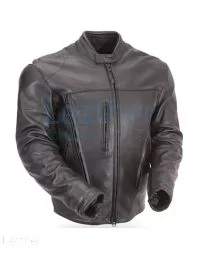
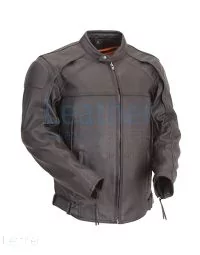
Leather is the traditional choice for abrasion resistance, and race-style garments are a good illustration. The range of and sport-oriented jackets such as those in are typical of sport-oriented leather jackets; the category pages list the individual designs.
The test method does not depend on the material. For EN 17092, specimens are mounted on rotating arms above a concrete tile and left to impact and slide to a stop, and a garment passes if no hole of 5 mm or larger opens in the layer closest to the body. SATRA also describes the Cambridge machine, which drops samples onto a moving abrasive belt, and the Darmstadt machine. Tests also cover tear strength and seam strength, which is why stitching quality counts as much as the hide or the fabric.
What the EN 17092 classes tell a rider
The standard has five garment classes: AAA, AA, A, B and C. Elbow, shoulder, knee and hip impact protectors are mandatory in Class AAA and AA garments, and hip protectors are optional in Class A. Class B garments give abrasion protection equivalent to Class A but without impact protectors, while Class C garments cover only the areas where protectors sit and offer no minimum abrasion protection. EN 17092 classes are assigned to a tested garment, not to a material.
Weather, Comfort and Ventilation
Here textile usually has the edge. Synthetic jackets tend to offer better protection from heat, cold and water, and they often include waterproof liners made from membranes such as Gore-Tex. They can also carry more zippered vents, which matters when temperatures climb.
Leather is not without answers. Some leather jackets are offered with a waterproof or thermal liner, and each product page states what is included. The product page of the lists a removable waterproof rain liner, and the page of the lists a zip-out insulated liner. Neither page gives a waterproofing rating or test standard. Leather generally breathes less visibly than a vented textile shell, so riders in hot climates should look closely at perforation and liner design.
Fit, Weight and Everyday Use
Leather tends to feel stiff when new and then moulds to the rider, and it is often worn off the bike as a regular jacket. Textile jackets are usually softer straight away, adjust more easily over layers and carry more storage. Impact protectors only work where they sit, so a jacket that shifts on the body defeats part of its purpose; fit therefore matters in both materials. Riders with unusual proportions may look at made-to-measure options; the product page for lists a Custom Size option, with measurements submitted after ordering.
Care and Ownership
Care differs by material, and no single routine fits every garment. Follow the care label and the maker's instructions: the right product depends on the leather's finish and construction, and textile membranes have their own washing guidance. Leather that gets soaked should be handled according to those instructions instead of improvised heat drying.
Choosing Between Leather and Textile
Start with where and how the jacket will be used. Short, dry, sporty rides favor a close leather fit; year-round commuting in changeable weather favors a textile jacket with liners; mixed use may call for either with the right layers. For any jacket, check the product page for the armour listed, ask for the documentation on the armour, and compare the garment label against the EN 17092 class you want.
Frequently Asked Questions
Is leather safer than textile for motorcycle riding?
Neither material is automatically safer. Protection depends on the thickness and construction of the garment, seam strength, the impact protectors fitted and how well it fits. EN 17092 classes garments by tested performance, so a specific jacket should be judged by its label and documentation rather than by the material category alone.
Are textile jackets better in the rain?
Textile jackets often include waterproof liners, so they are commonly easier to keep dry. Some leather jackets also add a waterproof layer, but the result depends on the design. Check the description of the specific jacket and its lining before assuming it will cope with sustained wet weather.
Do both materials accept armour?
Yes. EN 17092 expects impact protectors in the higher classes regardless of the outer material. The armour level for a jacket can differ between models, so check what the product page lists for armour, and ask for the documentation before relying on any level of protection.
How should leather and textile jackets be cleaned?
Follow the garment care label and the maker instructions, because the right method depends on the finish and construction of each jacket. Leather and textile membranes are cared for differently, and a method that suits one can damage the other, so avoid improvised cleaning products.
Written by the Leather Collection Editorial Team.