
 USA
 Canada
 Brazil
 Germany
 France
 Italy
 Switzerland
 Sweden
 Spain
 Great Britain
 Norway
 Russia
 Japan
 New Zealand
 Australia

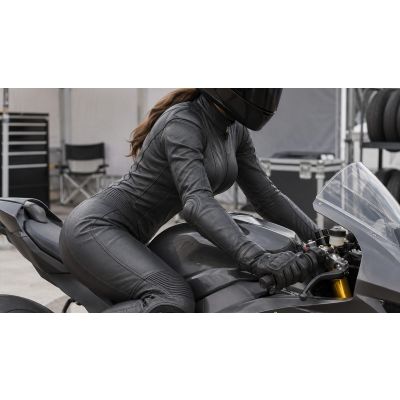
Short answer: A woman's race suit has to fit the bust, waist, hips and torso length together, and off-the-rack unisex cuts often miss on one or more of them. Measure carefully, size for the biggest problem area, and consider made-to-measure if two or more measurements do not fall in the same size.
A race suit is not like a jacket. It is a single garment from neck to ankle, cut to be close, and it is worn in a crouched riding position that stretches some areas and compresses others. A fit problem that is easy to ignore in a shop becomes obvious at 60 mph. This guide explains the typical mismatches, how to measure, and how to check fit at home.
Why unisex cuts often miss
Many standard suits are cut on a male pattern and sold in numbered sizes. A woman who fits a size 40 at the chest may find the hips too tight or the waist too loose. Common mismatch areas include:
- Bust: too tight and the chest is pressed, too loose and the armor shifts.
- Hips and thighs: a suit sized for the chest can pinch at the hip or the thigh.
- Waist: extra fabric bunches in the crouch.
- Shoulders: a wide shoulder drops the sleeve and moves the armor away from the joint.
- Torso length and leg length: a short torso lets the suit pull on the shoulders when you lean forward.
Bodies vary a lot, so these are patterns, not rules. The point is to check each area, not trust a single size label. Our women's gear is cut from women-specific patterns with bust, waist and hip shaping, and Custom Size covers anything else.
What to measure
Use a soft tape measure. Wear thin, close base layers, stand relaxed and breathe normally. Ask someone to help for the back and torso measurements.
| Measurement | How to take it | Common mistake |
|---|---|---|
| Bust | Around the fullest part, tape level at the back | Pulling the tape tight or letting it slip down the back |
| Waist | Around the narrowest part of the torso | Measuring at the belt line instead |
| Hips | Around the fullest part of the hips and seat | Tape too high |
| Torso length | From the base of the neck, through the legs, to the same point at the back | Measuring only front or back |
| Shoulder width | Across the back from shoulder bone to shoulder bone | Measuring over thick clothing |
| Arm length | Shoulder bone to wrist with the elbow slightly bent | Arm straight and stiff |
| Inseam | Crotch to ankle bone | Measuring over shoes |
| Thigh | Around the fullest part of the upper leg | Standing with weight on one leg |
Write the numbers down and measure twice. Our size chart lists standard measurements to compare against, and the perfect fit guide to sizing a race suit goes into each one in more detail.
Bust and chest
The chest area has to leave room for a sports bra, the chest armor if the suit has it, and the movement of breathing. Too tight can feel like pressure and restrict breathing. Too loose lets the suit gap and the armor drift. Leather does not stretch much in the first few wears, so a snug fit that feels fine in the changing room can get tighter when you lean forward.
If you wear a sports bra on the bike, wear it when you measure and when you try the suit.
Hips, thighs, torso and crotch rise
In the crouch, the suit pulls from the shoulders to the seat. If the torso is too short, the shoulders lift and the crotch seam pulls up. If it is too long, you get folds at the waist and knee. Check these areas:
- Hips and thighs: you should be able to bend the knees and sit on the bike without the leather biting at the hip crease.
- Crotch rise: a rise that is too short pulls up when you sit forward. Too long and the knee armor sits low.
- Knee position: the armor should sit over the kneecap in the riding position, not below it.
The hump and back protector on a smaller frame
The hump on the back of a race suit holds a back protector or sits as an aerodynamic shape. On a smaller frame, an oversized hump can sit too high or too wide and stick up above the shoulders. See our guide to the aerodynamic hump on a racing suit for what the hump does. For fit, what matters is that any back protector covers the length of your spine and does not ride up when you tuck in. Ask the maker how protector size is chosen for shorter riders, and check the product page for the protector options.
Standard sizes or made to measure
| Standard size | Made to measure | |
|---|---|---|
| Best when | All measurements fall in one size | Two or more fall in different sizes |
| Strength | Faster, usually lower cost | Fits bust, hip and torso together |
| Limits | Cannot fix proportion differences | Depends on accurate measurements |
| What you provide | Height, weight, chest | A full measurement set |
Made to measure fixes proportion problems, because each part of the suit is cut to your numbers. It does not fix a bad measurement. If your tape was off by an inch at the hip, the suit will be off by an inch at the hip. See our custom race suits page for how an order works. You send your measurements through the measurement form after you order. Custom Size orders take 3-4 weeks and Custom Made orders 4-6 weeks, followed by 3-10 working days of delivery.
The 60-second fit test in the riding crouch
Try this when the suit arrives, inside, and only to check fit. It is not a substitute for a trial on a bike with a professional fitter.
- Put on the suit with the same base layers you will ride in. Zip it fully.
- Stand and raise both arms in front. The sleeves should not ride far up your wrists.
- Squat slightly, then lean forward with your hands out as if holding handlebars. Look for pulling at the shoulders, bunching at the waist or pressure at the hip.
- Sit on a chair or bike with your knees bent. Check that the knee armor sits over the kneecap.
- Breathe in deeply. The chest should feel snug but not squeezed.
- Hold the position for 30 seconds. Notice any pressure that gets worse.
Do not wear a suit outdoors if you may want to return it. Returns are accepted within 14 days of delivery, with approval, only if the item is unused and has its tags. A 25% restocking fee and shipping apply, and custom-made items cannot be returned.
Common fit problems and what they mean
| What you notice | Likely cause | What to check |
|---|---|---|
| Suit pulls on the shoulders when you lean forward | Torso too short | Torso length measurement against the chart |
| Fabric bunches at the waist | Waist too loose compared with the chest or hips | Waist and hip measurements |
| Chest feels pressed when you breathe in | Bust area too tight | Bust measurement and any chest armor |
| Knee armor sits below the kneecap | Leg length too long or rise too long | Inseam and crotch rise |
| Sleeves ride up toward the elbow | Arms too long in the pattern, or shoulder too wide | Arm length and shoulder width |
| Hump sits above the shoulders | Hump too large for the frame | Hump size and protector length |
Most of these problems come from one or two measurements that differ from the size on the chart. That is why we suggest ranking the measurements by how far each one is from your nearest size, and solving for the largest gap.
What made-to-measure fixes, and what it cannot
Made to measure can fix proportion: a long torso with short legs, wide hips with a narrower chest, a long arm or a short one. It can make sure the armor lines up with your joints because each panel is cut to your numbers.
It cannot fix a suit that is ordered with wrong measurements. It cannot change a body that changes after the order, for instance through weight change, so allow for that if you expect it. It also cannot make a suit comfortable in positions it was not cut for. A suit cut for a sport-bike crouch will feel stiff when you stand upright for long periods. That is normal for a race suit.
If you plan to ride track days, ask a fitter or an experienced rider to look at the suit in the riding position, with the armor in place.
Ordering checklist
- Measure twice, with thin base layers.
- Note which two measurements are the furthest apart on the size chart.
- Decide whether standard or made to measure fits that gap.
- Ask what armor and back protector come with the suit, and how they are sized.
- Keep your measurements and the order details in one place.
See also our general guide to selecting the correct racing suit size.
Ready to order? Get a one-piece suit made to your measurements in our custom race suits, or browse the ready-made leather race suits.
FAQs
How should a women's race suit fit?
Snug everywhere, with no gaps, no pinching and no pulling in the riding crouch. Armor should sit over the joints, and the suit should let you breathe fully.
Do I need a women-specific race suit?
Not always, but many women find that a women-specific cut or a made-to-measure suit fits the bust and hips better than a unisex size. Check each measurement against the chart.
What size should I order if my bust and hips differ?
We do not alter suits after delivery, so if your bust and hips fall in different sizes, choose Custom Size and send your measurements.
Can a race suit be made to measure?
Yes. A made-to-measure suit is cut from your own measurements. See our custom race suits for the process.
How tight should a race suit be?
Close fitting, but not restrictive. It should feel snug standing and comfortable in the riding crouch. Leather softens with wear, so a suit that is only slightly firm at first may relax.
Where does the back protector sit on a smaller rider?
It should cover the spine from the base of the neck to the lower back, without sitting above the shoulders or pressing the hips. Ask the maker how the protector is sized.