
 USA
 Canada
 Brazil
 Germany
 France
 Italy
 Switzerland
 Sweden
 Spain
 Great Britain
 Norway
 Russia
 Japan
 New Zealand
 Australia

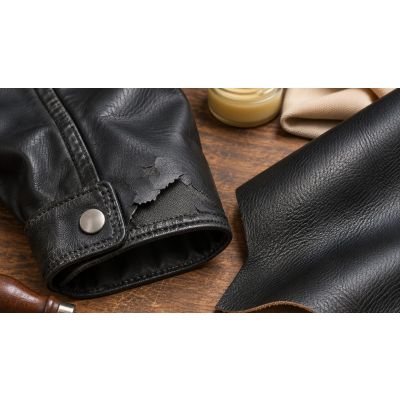
Short answer: Peeling or flaking is a strong sign of a coated material such as PU or bonded leather, not full-grain hide. It usually cannot be repaired for good. Check the label and the cut edge, and if the coating is lifting in many places, replace the jacket rather than patch it.
What peeling usually means
Many jackets sold as leather or "leather-look" are a thin coating on a fabric or fiber backing. Over time, the coating separates from the backing, and it lifts, flakes or comes off in sheets. That is peeling.
It is different from other problems that can look similar:
- Peeling coating: a surface layer lifts away and exposes fabric or fibers underneath.
- Shedding dye or finish: color rubs off onto clothes or the surface looks patchy, but there is no layer lifting.
- Dry or cracked real leather: fine cracks appear in the grain, often at flex points, but nothing comes off in flakes.
The distinction matters because the fixes differ.
Is it real leather? Quick checks
- Read the label. Wording such as "bonded leather", "PU", "polyurethane", "faux", "vegan", "man-made" or "leatherette" signals a coated or reconstituted material. A label that only says "genuine leather" can still describe a low-grade layered product, so look further.
- Look at the cut edge. Check a hem, an inside seam or an edge. Real leather shows a fibrous, uneven edge. A coated material shows a smooth plastic layer on top of fabric.
- Look at the grain. Real leather has an irregular surface with small variations. A very uniform, repeating pattern points to a printed surface.
- Feel and smell. Real leather has a warmth and a characteristic smell. Plastic coatings feel cooler and smoother and smell of plastic.
No single test is conclusive, so use several. For a longer walk-through, see how to tell real leather from fake.
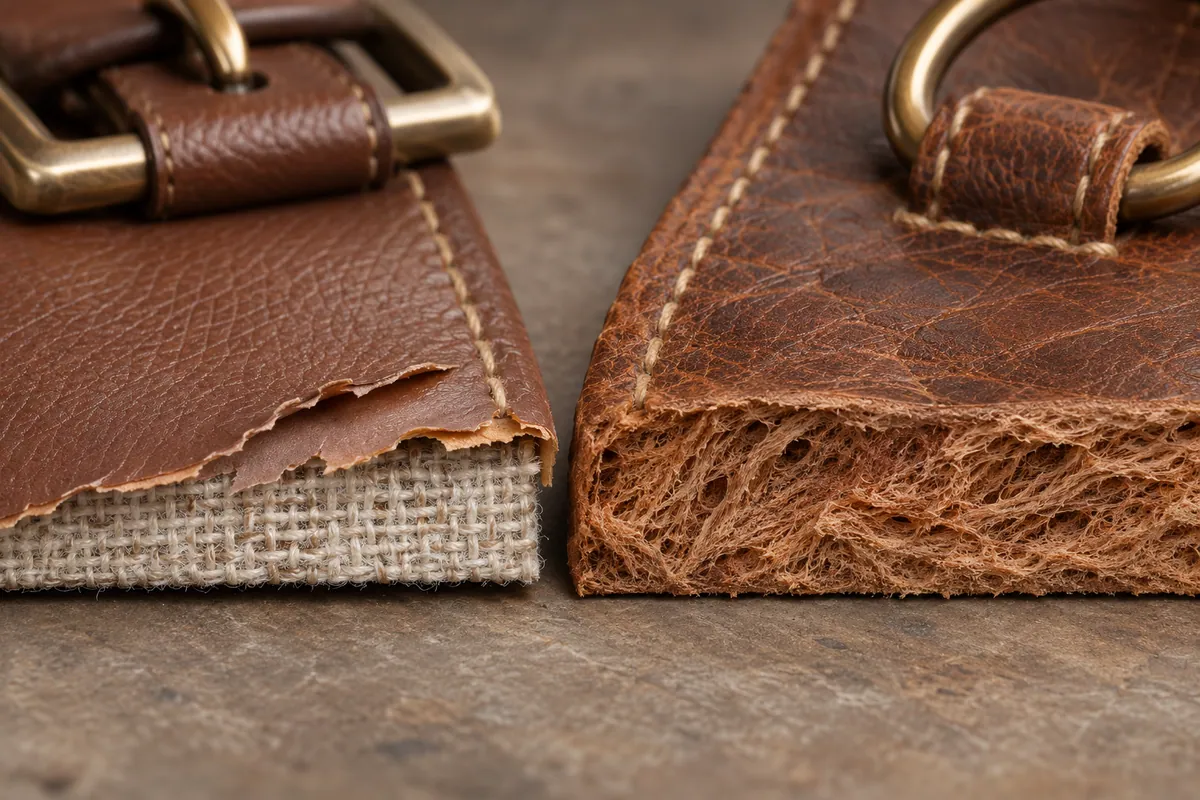
When real leather flakes
Real leather can show wear, though it behaves differently. Dry leather develops cracks. A wax or pigment finish can wear thin at the elbows, the cuffs and the collar. Sometimes a top finish coat on a pigmented leather chips in small flakes, which can be treated.
What helps: clean the area gently, let it dry, and apply a suitable leather conditioner after testing on a hidden spot. Prevent more drying by keeping the jacket out of heat and sun. Our guide to how to care for leather gear explains the routine, and the DIY leather repair guide covers small surface repairs.
The difference with a coated material is that real leather's damage stays in the hide. The leather underneath is still sound.
What you can fix and what you cannot
| Problem | Real leather | PU / bonded |
|---|---|---|
| Surface scuff | Often fixable with cleaning and conditioner | Cosmetic touch-up only |
| Small flake | May be treatable if it is finish wear | Will usually spread |
| Widespread peeling | Unusual; consult a specialist | Replace |
| Cracked grain | Conditioning can improve it if caught early | Not repairable |
Why repairs on PU do not last
A polyurethane coating is bonded to its backing in manufacture. Once the bond fails, you cannot re-bond it at home. Glue, patches and fillers may hide the damage for a while, but the surrounding coating keeps lifting, because the same aging is happening everywhere. Products sold to fix peeling faux leather are temporary at best.
That is why it makes sense to treat a widely peeling coated jacket as finished, and to think carefully about the next purchase rather than buying another coated jacket.
Why coatings fail
A coated jacket is made of layers: a thin surface film, a bonding layer and a fabric or fiber backing. Every time you move, the layers flex against each other. Heat, sweat, sun and cleaning products weaken the bond. Folding and storing the jacket creases the film. Eventually the film cracks at a flex point, such as the elbows, and begins to lift. Real leather is a single, fibrous material with no layer to separate, which is why it ages by wearing and creasing, not by peeling.
This does not mean every coated product fails fast, or that every piece of real leather lasts forever. Quality varies in both. But a failure of this kind, where a surface layer comes away, is the typical pattern for coated materials.
A five-minute triage
- Find the label. Write down the wording.
- Look at the cut edge inside a hem or seam.
- Check where the damage is: flex points only, or everywhere?
- Decide: a few small spots on real leather means treat; widespread peeling on a coated jacket means replace.
- If the jacket is new and peeling quickly, contact the seller; the product may not match its description.
What to do with a ruined jacket
If the jacket is beyond repair, do not keep wearing it while the coating sheds, since it can mark other clothes. Check whether the seller offers a return or refund, if it was bought recently, and keep photos of the damage. Textile recycling facilities and charity shops often will not accept peeling garments, so check local guidance before donating one.
How to buy so it does not happen again
- Look for clear material names. Terms like "full-grain" or "top-grain" describe real leather layers. Full-grain vs top-grain leather explains what they mean.
- Be wary of vague words. "Genuine", "leather-look", "vegan" and "faux" tell you little about durability.
- Ask the seller. A maker of real leather jackets will say what hide the jacket is made from. Leather Collection product pages state the leather and its thickness.
- Compare cost per year, not the price tag. A coated jacket that lasts one or two seasons can cost more over time. See vegan leather vs real leather for how to work that out.
Caring for what you own
- Clean gently with a soft, slightly damp cloth, and avoid solvents and household cleaners.
- Do not fold the jacket for long storage; hang it on a wide hanger.
- Keep it away from heat and direct sun, which age both real leather and coatings.
- Do not scrub a flaking area. It makes the damage larger.
FAQs
Why is my leather jacket flaking?
Most often because it has a surface coating, such as PU, that is separating from a backing. Dry or worn finish on real leather can also flake in small amounts.
Can you fix a peeling leather jacket?
Small finish wear on real leather often can be treated. A coated or bonded jacket that is peeling widely cannot be repaired for good.
Is peeling leather real leather?
Usually not. Peeling points to a coating over a fabric or fiber backing. Check the label and the cut edge.
How long should a real leather jacket last?
It depends on the hide, the build and how you wear and care for it. A well-made full-grain jacket that is looked after can last many years. We do not give a fixed figure.
What can I use to fix peeling faux leather?
Repair kits and patches exist, but they are temporary. When the coating lifts across a large area, replacement is the sensible option.
Replace it with a jacket made to last: see custom leather jackets or browse men's leather clothing.