 USA
USA  Canada
  Brazil
  Germany
  France
  Italy
Italy  Switzerland
  Sweden
  Spain
Spain  Great Britain
  Norway
  Russia
  Japan
Japan  New Zealand
  Australia
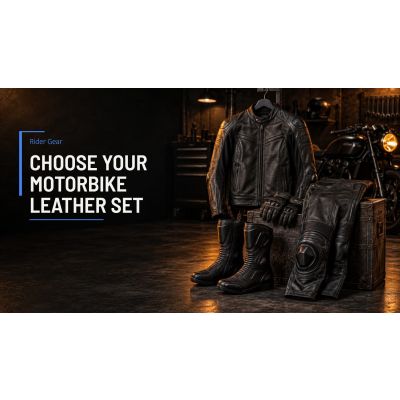
Motorbike leathers, also called biker leathers, are protective riding clothing made from leather, worn as a one-piece suit or as a jacket and trousers pair, with armour over the joints that are most exposed in a crash. Choosing a set comes down to four things: the style (one-piece or two-piece), the leather and its construction, the armour and how it is positioned, and above all the fit on a moving rider. This guide explains each of them in plain terms.
The term is used loosely. Some riders mean a full track suit from a range such as , others mean a leather jacket with matching trousers for road use, and shops use both words for the same garments. Sorting out which of those you actually need makes the rest of the decision much easier.
Key Takeaways
- Leathers come as one-piece suits or two-piece sets; the choice affects how the garment is worn, how it is stored and how it behaves on and off the bike.
- Leather type, thickness and stitching matter more than outward styling, and the garment label or product page is where to check them.
- Armour only works when it sits over the joint in a riding position, so fit is tested on the bike, not standing up.
- EN 17092 is the standard for protective garments, with five classes from AAA to C; ask for the documentation of any specific garment.
What Motorbike Leathers Are
The Wikipedia overview of motorcycle protective equipment describes leathers as one-piece suits or two-piece jackets and trousers worn by motorcyclists mainly for protection in a crash. It also notes that protective leather is thicker and stronger than fashion leather and is only moderately flexible. How a given suit performs depends on its construction and documentation, not on the word leather alone.
In practice a set has three parts. The outer shell is the leather itself, panelled and stitched so that the seams carry load. The armour sits in pockets inside the shell at the shoulders, elbows, hips and knees, and often along the spine. The lining and any stretch or perforated panels handle comfort. A suit that looks good but has a flimsy shell or loose armour is a costume, not riding gear.
One-Piece or Two-Piece Leathers
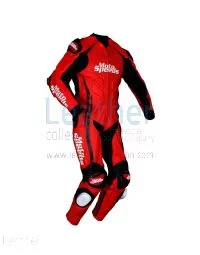
A one-piece suit has no waist join, so there is no gap between jacket and trousers where the garment can ride up. A one-piece suit is common at track days. Browsing shows the one-piece designs on offer.
A two-piece set is made of a jacket and trousers, normally joined by a zip around the waist. That makes it easier to put on and take off, and the pieces can be worn apart. The trade-off is the join itself, and the quality of the zip and the overlap around it. The range lists the two-piece designs; check how the jacket and trousers connect before deciding.
| Point | One-piece | Two-piece |
|---|---|---|
| Waist join | None | Zip connection between jacket and trousers |
| Getting dressed | Slower, needs a fitting routine | Easier, two pieces to handle |
| Flexibility of use | One garment, one purpose | Jacket or trousers can be worn separately |
| Fit tuning | Single size to match top and bottom | Top and bottom sizes can differ more easily |
Leather Type and Construction
Cowhide is the most familiar material for motorcycle suits. The Wikipedia overview of motorcycle protective equipment also mentions kangaroo leather, which it says is becoming popular for its suppleness, light weight and strength compared with cowhide. Which one suits a rider depends on how the garment is made and what the maker states, so the product description is the place to confirm it.
Beyond the hide, look at the following details, which can be inspected on a garment in the hand or in the product photographs:
- Stitching: double rows on high-stress seams, with thread that is not sitting on the surface where it would wear away first.
- Panel layout: fewer exposed seams on the outer arms, hips and knees.
- Stretch zones: panels at the back of the knee, crotch and underarm that allow movement without pulling the armour out of position.
- Lining: breathable and smooth enough to put on over base layers without sticking.
- Closures: heavy zips with storm flaps, and secure adjusters at the waist and cuffs.
A made-to-order suit, such as the , can be ordered in standard sizes or with custom measurements according to its product page, so check how sizing is handled there. Custom measurements suit riders whose proportions fall between standard sizes.
Armour and the EN 17092 Standard
The protective value of leathers depends on armour as much as on the shell. SATRA describes EN 17092:2020 as the standard for protective clothing for motorcycle riders, covering jackets and trousers as well as one- and two-piece suits. It has five classes, AAA, AA, A, B and C. According to SATRA, elbow, shoulder, knee and hip impact protectors must be present in class AAA and AA garments, hip protectors are optional in class A, class B covers abrasion protection without impact protectors, and class C covers impact protection only.
That tells a buyer how to read a label: the class describes the garment as a whole, not just one panel. It does not say how a particular suit from any maker performs, and a class should not be assumed from the look of a suit. The same source describes abrasion testing as simulating a rider sliding across concrete, with a pass requiring that no specimen shows a hole of 5 mm or more on the layer closest to the body.
Individual armour inserts are tested separately under their own standards, with levels that indicate how much impact force they let through. When shopping, check the armour listed on the product page, and ask for the documentation of the garment and the inserts before relying on any protection claim.
Fit and Sizing on the Bike
Leathers should fit snugly in a riding position, not in a standing one. Armour that slides a few centimetres off the elbow or knee under load is not covering the joint. The check is simple: sit on the bike or in a crouch, reach for the bars, and watch where the shoulder, elbow and knee armour ends up. A garment that feels tight when upright often relaxes into the right shape once the rider is tucked in.
Measurements normally needed are chest, waist, hips, inseam, arm length and height, plus shoulder width and thigh circumference for a close fit. Men's cuts and women's cuts differ in the chest, waist and hip shaping, so start from the right range: see the or the pages and then confirm with the size chart.
Allow for the base layer you will wear, and for the fact that leather softens with use. Over-tight sizing makes riding tiring and can restrict circulation, while an oversized suit allows the armour to move. If a supplier offers custom measurements, that is the quickest way to avoid both problems.
How to Choose a Set
A short sequence helps narrow things down.
- Decide the use: track days, road riding or occasional use.
- Pick the style: one-piece or two-piece, with the join and zip quality checked for two-piece sets.
- Check the shell: leather type, panelling, stitching, stretch zones.
- Check the armour: which inserts are fitted, whether they can be upgraded, and what documentation is available.
- Confirm the fit with full measurements, and see how it behaves in a riding position.
- Think about the rest of the kit: gloves, boots and a back protector complete the system.
Of those, are the part that most often gets left to last, so budget time for them early.
Frequently Asked Questions
What is the difference between motorbike leathers and biker leathers?
The terms overlap. Motorbike leathers usually means protective riding clothing, such as a race suit or a jacket and trousers set with armour, while biker leathers can also cover fashion jackets and vests. For protection, look at construction, armour and documentation rather than the name used.
Are one-piece or two-piece leathers better?
Neither is better in every case. A one-piece suit has no waist join and is common at track days. A two-piece set is easier to put on and its pieces can be used separately. Choose by use, then weigh the points in the table above and check the quality of the zip join and fit in a riding position.
What does EN 17092 mean on a label?
EN 17092 is the standard for protective clothing for motorcycle riders. It has five garment classes, AAA, AA, A, B and C, which differ in abrasion requirements and in which impact protectors must be present. A label should be backed by the maker's documentation for that specific garment.
Do leathers need armour?
Armour over the shoulders, elbows, hips and knees is a normal part of a protective set, and under EN 17092 it is required in classes AAA and AA. Check which armour a garment includes or offers as an option, and ask for the documentation of the inserts.
Written by the Leather Collection Editorial Team.