 USA
USA  Canada
  Brazil
  Germany
  France
  Italy
Italy  Switzerland
  Sweden
  Spain
Spain  Great Britain
  Norway
  Russia
  Japan
Japan  New Zealand
  Australia

A new leather jacket or race suit is broken in by wearing it, moving in it and sitting in the riding position until the hide and the seams loosen around the body. There is no shortcut that is safe for every garment, so the first step is the care label and the maker's instructions. The steps below cover what to do before the first ride, how to wear the garment in gradually, and which tempting shortcuts are better left alone.
Key Takeaways
- Check the care label and the maker's instructions before doing anything to a new garment.
- Wearing the garment and moving in riding positions is the safest way to loosen it.
- Stiffness is normal at first; pinching, numbness or restricted breathing points to a sizing problem.
- Avoid soaking and direct heat unless the care label allows it; hot water can damage vegetable-tanned leather.
What breaking in actually means
Leather is tanned animal hide. According to Wikipedia's overview of leather, tanning stabilises the proteins in the raw hide, particularly collagen, and a tanned hide dries to a flexible form instead of the hard, inflexible state of raw hide. That flexibility is why a new garment can soften with use, but it is also why every garment feels different: thickness, finish, lining and panel construction all change how stiff it feels on day one.
Breaking in is mostly about three things changing together. The leather flexes at the elbows, knees and shoulders. The panels and seams settle into the shape of the rider. The lining and any armour pockets take on the rider's posture. A garment that feels stiff and slightly tight is normal; one that cuts off movement is a fit question, not a break-in question.
Before the first wear
Read the care label first
The right treatment depends on the leather's finish and construction, so the label and the maker's instructions come before any home method. Some finishes tolerate certain products and others do not. If the instructions are missing or unclear, ask the seller before applying anything.
Check the fit while standing and seated
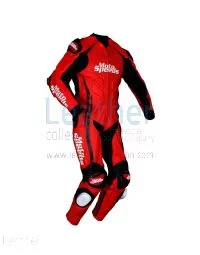
Try the garment on with the layers it will be worn over, then check it in a riding posture: arms forward as if holding the bars, knees bent, back slightly rounded. Race suits in particular are cut for the riding position, so they often feel awkward when standing upright. The page shows the formats available, including one-piece and two-piece suits.
Do not buy a size too small in the hope that it will stretch to fit. Leather gives a little in the right places, but it does not replace a correct size. Use the size chart and take body measurements before ordering, and ask for guidance if you sit between sizes.
Wearing it in, step by step
- Start indoors. Wear the garment around the house for short sessions with the base layers you will ride in. Move normally: walk, sit, reach, twist.
- Practice the riding position. Sit on the motorcycle, on its stand, and hold the riding posture for a few minutes at a time. Reach for the bars, tuck the knees and lean forward so the elbows, knees and shoulders flex where they will on the road or track.
- Add short rides. Keep the first rides short and relaxed. Real riding movement does what no indoor routine can.
- Build up gradually. Lengthen the sessions as the garment becomes more comfortable, rather than judging it on the first hour.
Because there is no fixed timetable, judge progress by comfort instead of a number of days. Timing varies by garment. A race suit such as the is cut for the riding position, so seated practice matters.
Jackets compared with race suits
| Point | Leather jacket | Race suit |
|---|---|---|
| Main stiff areas | Shoulders, elbows, collar | Shoulders, elbows, hips, knees, back |
| Approach | Wear with a normal layer, then ride short distances | Practice the tucked riding position, ideally on the bike |
| Common problem | Tight upper arms or shoulders | Pulling at the crotch, knees or collar when upright |
| First check | Care label | Care label and fit in riding position |
A jacket is usually worn by more riders in daily conditions, which means it relaxes through ordinary use. For a woman looking at suit shapes, the page lists cuts designed for female riders, which matters because cut affects how much a garment has to adapt. The same logic applies to leather jackets where sleeve length and shoulder width decide comfort long before softness does.
Shortcuts to avoid
Online advice for speeding up softening often involves water, heat or heavy products. Wikipedia notes that vegetable-tanned leather shrinks in hot water and can turn rigid and eventually brittle, so soaking a garment or exposing it to direct heat carries real risk.
Conditioners and creams are a separate question. Whether any product suits the garment depends on the finish, the lining and the maker's guidance, so apply nothing unless the care label or the maker says it is suitable. Testing on a hidden area is cautious practice, and no product should be expected to repair a poor fit.
When it is not just stiffness
Normal break-in feels like resistance that eases with use. Warning signs are different: numbness in the arms, pressure that does not ease, difficulty taking a full breath, or armour sitting away from the joint it is meant to cover. These suggest the size or cut needs attention. The riders who match a suit to their measurements first usually spend less time fighting it later. Anyone choosing a men's cut can look at the and compare the size information before ordering.
Gloves, boots and other leather items have their own break-in pattern, so check their instructions separately rather than copying the jacket routine.
Frequently Asked Questions
How long does it take to break in a leather jacket?
There is no fixed time. It depends on the thickness of the hide, the finish, the lining and how often the garment is worn. Judge progress by comfort in the riding position rather than by a number of days, and extend the sessions gradually as the leather flexes at the elbows and shoulders.
Can I use conditioner to soften a new leather jacket faster?
Only if the care label or the maker says a product is suitable. The right choice depends on the finish and construction of the leather, and the wrong product can mark or alter it. If the instructions do not cover it, ask the seller before applying anything to the garment.
Should a new race suit feel tight when standing up?
A race suit is cut for the riding position, so some pulling when standing straight is common. Check the fit with arms forward and knees bent. If there is pressure that does not ease, numbness or restricted breathing, the size or cut may be wrong, and it is worth checking the size chart again.
Is it safe to soak or heat leather to make it softer?
It is not recommended. Wikipedia notes that vegetable-tanned leather shrinks in hot water and can become rigid and brittle. Soaking or direct heat can also damage finishes, linings and stitching. Wearing the garment and moving in the riding position is the gentler approach.
Written by the Leather Collection Editorial Team.